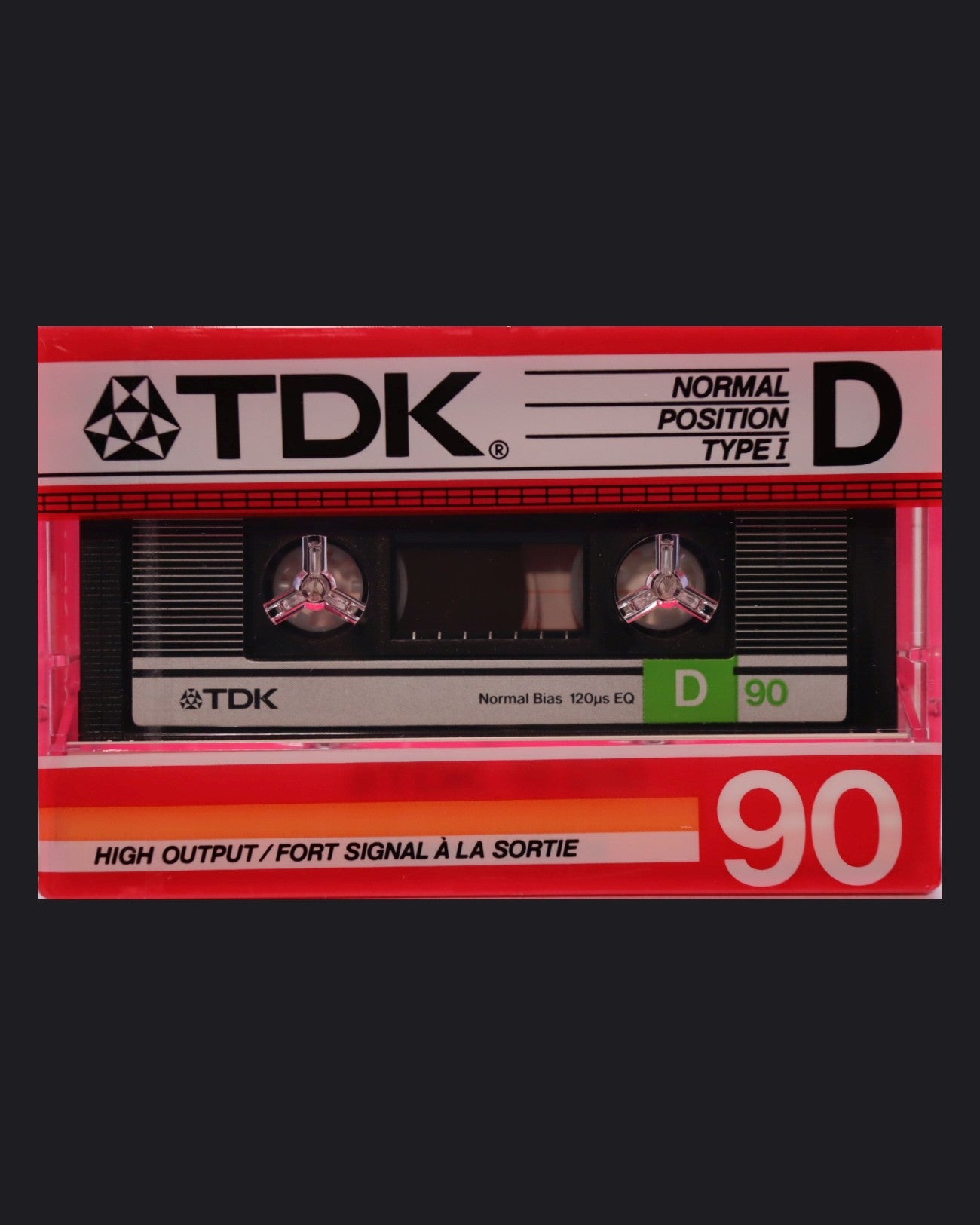
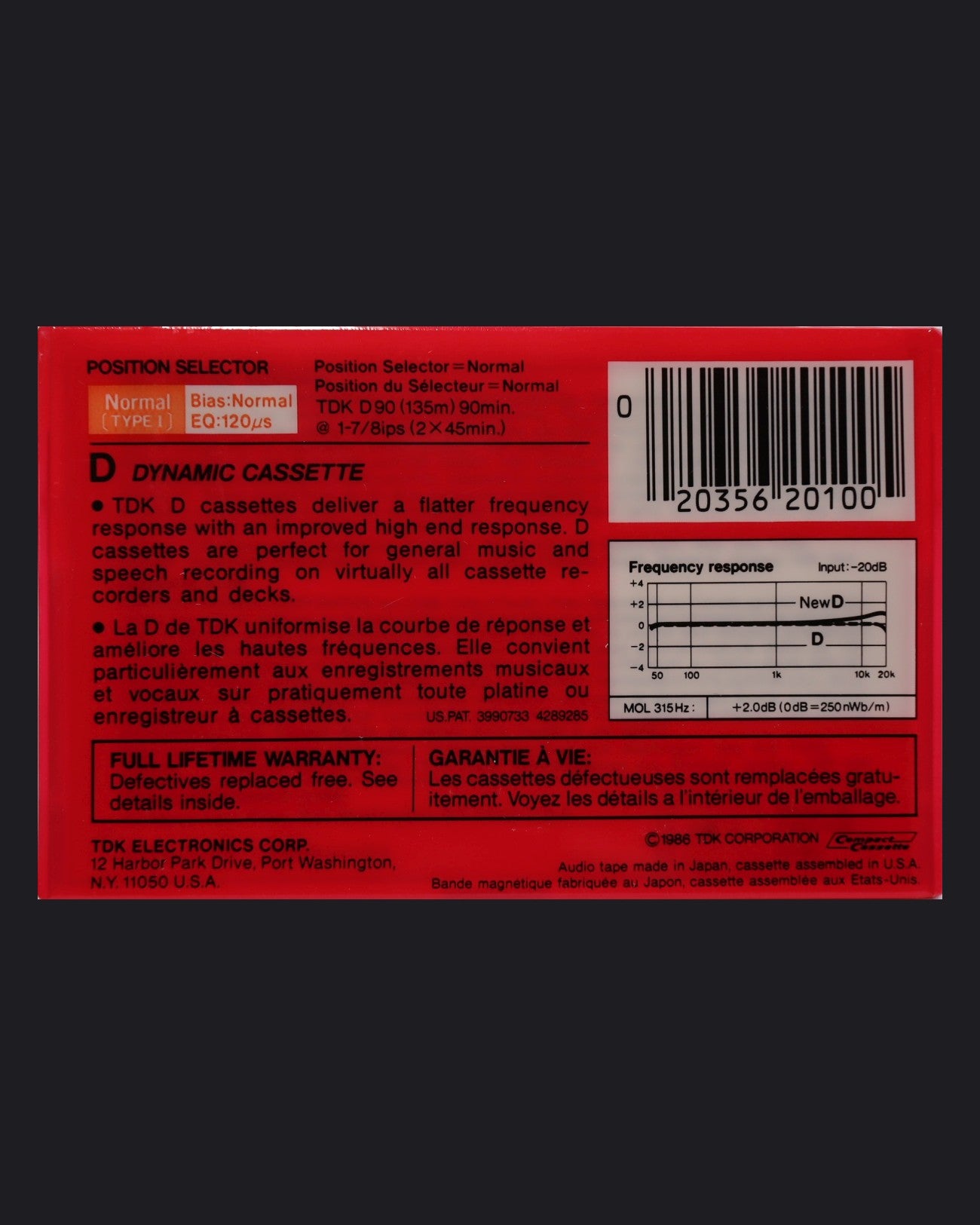
TDK D Type I - 1986-1987 US
TDK D Type I - 1986-1987 US
 Risk free purchase: If it is damaged, we replace it or refund you.
 Sourced through trusted channels; Climate-controlled storage.
 New Old Stock- Not manufactured anymore. Limited quantities.


In stock
Couldn't load pickup availability
🚚 Shipping cost calculated at checkout · Free US shipping over $75 · Returns accepted within 14 days
TDK D (1986-1987 US) Cassette Tape
TDK D Cassette Description
The TDK D (1986-1987 US) is a Type I audio cassette designed for general-purpose recording and playback. It was widely used during the early to mid-1980s due to its balance of price, performance, and reliability. This cassette tape is known for its warm and full-bodied tone, making it suitable for a variety of audio applications.
TDK D Technical Specifications
- Magnetic Particle: Grained Ferric
- Coercivity: 380 Oe
- Remanence: 1450 Gauss
- Squareness Ratio: 0.81
- Operating Bias: -0.5 dB
- MOL 315Hz: +3.0 dB
- MOL 10kHz: -8.0 dB
- Sensitivity at 315Hz: -0.5 dB
- Sensitivity at 3.15kHz: -0.5 dB
- Sensitivity at 10kHz: -0.3 dB
- Sensitivity at 16kHz: -0.0 dB
- Bias Noise: -55.0 dB
TDK D Key Features
- Balanced Performance: Offers a reasonable balance between price and technical specifications.
- Warm Tone: Known for its warm and full-bodied sound quality.
- Bass Reproduction: Can reproduce significant bass frequencies.
- Reliability: Widely used and respected for its reliability.
Improvements Over Previous Generation
The TDK D evolved from the TDK LN and was first introduced around 1972. It represents an improvement in terms of availability and distribution, as it was sold under the TDK AE name in Japan starting from 1987. The TDK D cassette maintained a consistent performance level throughout its production run, making it a reliable choice for audio recording and playback during the early to mid-1980s.