Shop Top Brands
-
Sony Cassette Tapes
Sony Blank Cassette Tapes: The Standard in Analog Recording Sony Group Corporation...
-
TDK Cassette Tapes
TDK was founded by Kenzo Saito in Tokyo, Japan, on 7 December...
-
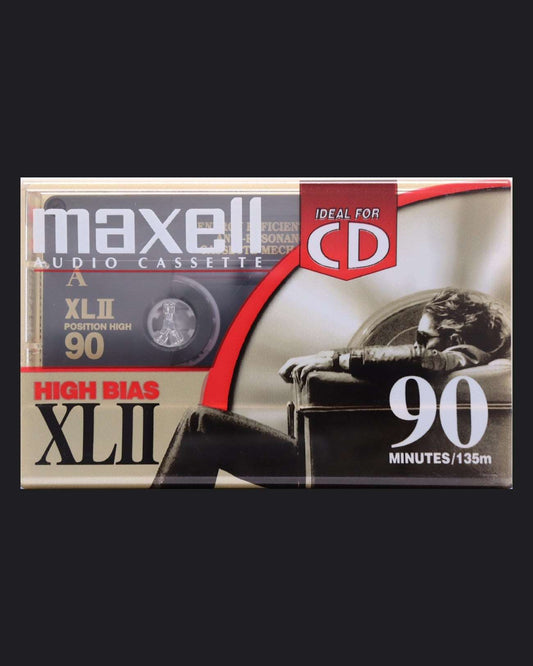
Maxell Cassette Tapes
Maxell, Ltd. (マクセル株式会社, Makuseru Kabushiki-gaisha), commonly known as Maxell, is a Japanese...
Let customers speak for us
from 52 reviewsMay15/26
Fun with TDK cassettes.
So I thought I would have some subjective fun with a select range of 1990s TDK cassettes tapes.
Set-up:
* The selection: AD, AD-X, AR-X, SA and SA-X. (no D, no MA*, no SR*, etc)
* Generations were within a couple of years. i.e. I didn't use a 1982 AD-X and a 1992 SA.
* All tapes were calibrated in the same manner, however, input signal was adjusted to the suggested best maximum.
* Noise reduction was turned off.
* A subjective song was chosen. Don't ask me what.
* I played the same segment on each tape until all tapes were eventually reviewed. Yeah, a lot of manual cassette ejections and insertions.
* I used over-the-ear headphones and kept equalization settings constant.
Disclaimer:
I tend to subjectively prefer a wee bit more treble in my sound replications. In other words, musty ol' BASF recordings - that perhaps once sounded good - are out for me. I also expect SA and SA-X to perform well. I need to consciously keep that personal bias under control.
Observations:
* No surprise: The TDK AD sounded the weakest, however, it was still acceptable to be proud to record and give away. If you never heard the others here, the AD sounded good. Note: The AD sounds as good or better than many comparable competitive brands of respective eras.
* A significant improvement was the TDK AD-X. I found the sound step quality was the greatest between the AD and AD-X. The AD-X was warm, clear and present. Noise did not bother me at all. It was a pleasant tape to listen to (but it was still not a SA).
* I found the sound of the TDK AR-X maybe marginally better in terms of clarity and presence over the AD-X. What the AR-X did manage well was a strong input signal - the strongest of the group without noticeable distortion. Bass punch was better than the AD-X. It was hard for me to determine if the noise floor was lower (I know it should be, but my gear may have soaked the difference up). I realize the AR-X is quite coveted, however, if I could not get one I would be satisfied with an AD-X.
* TDK SA - a standard for many did not disappoint. It was crisp and firm. Perhaps in some areas too crisp and maybe even noisier than expected. Overall, it sounded good to me. Refreshing, lighter than "warm". Bass sounded clean and not muddy in any way. To me it sounded more fulfilling than the AR-X.
* TDK SA-X - a legend in many people's mind did not disappoint. Compared to the "crispness" of the SA, the SA-X felt rounded and welcoming. There was lots of room for the sound to expand into, yet everything seemed to remain grounded.
SUMMARY:
In the end, it is the subjective perception of sound reproduction quality that matters. I suppose cost too. Today (in 2026) probably the best balance of value and quality goes to the TDK SA. I also find all generations of TDK SA incredibly durable going right back to 1979. For value, many would say TDK D, but in this lot it is the AD. The best experience made the SA-X win over me. If cost was not an issue, then AR-X and SA-X would be top choices.
Review May06/26
I found the (NOS) 1987 Scotch XS II (90) surprisingly bright and clear. I did not expect this and it was refreshing. If you like TDK SA of the same era, you will likely enjoy this cassette. When properly calibrated I found the noise floor very nice (no noise reduction). I targeted common peak signals to about +1 dB. I did not detect any sound drop outs. The calendaring of the XS II surface is not as uniform as a typical TDK SA, but that did not seem to degrade the sound quality.
Shipping was excellent, product is excellent
To my ears, the RD-x is absolutely equal to the DX-4, one of the highest quality type I tapes ever made. The RD-x mechanism is smooth, quiet and stable. It is an exceptional value at this price.
Excellent cassette tape. Highly recommended.
I have nothing but praise for these Maxell UR 10-minute cassettes. They are a solid choice, with a very decent range and a pleasant warm sound that has never left me dissatisfied.
It specifically meets my need of wanting 1-2 song tapes, much like a pre-recorded single, and so despite not having much wiggle room with extra seconds of slack, I still highly recommend it to anyone who’d ask me. I’ll always stock on these whenever they’re available!
The Axia A1 Color (5 Pack) was a very nice quality Type I tape. Recording on these tapes provided a solid sound with an average but decent range.
The real standout here is the presentation, and the 5 colors featured on cassette shells. They pop out in a collection, and make for both a solid shelf piece and a good choice for recording.
This tape calibrates effortless and makes wonderful recordings.
So this is the one. If I had to choose only one cassette tape for the rest of my life, the XLI-S would be my choice. It handles low frequencies like no other, for recordings with deep, full bass. Clear and balanced. It requires fine bias adjustment on all three of my three-head decks, so if your deck doesn’t have that option, it may not be a good choice.
Axia is quickly becoming one of my favorite brands of cassette tapes. The Axia AU-Ix has low noise compared to many of the major players’ type 1s. I’m able to get faithful reproductions of sources with this cassette. There is a very pleasant treatment of the high frequencies, without going too far. Really an excellent value.
These 2 tapes were in good condition. Calibrate ok and record ok.
For the 1985-87 production of this tape I recorded high energy rock music with integrated LUFS of around -10 (not a lot of dynamic changes). My recording levels had peaks just barely over +3 on a Nakamichi 482z. I found no need for noise reduction, as any hiss was negligible and didn’t distract from the tracks. Although it doesn’t take a super-high recording level, the BASF LH Maxima does not need to, as it has low noise for a type 1 tape. This is a very nice sounding tape. I will be purchasing more.
This one brings back memories of the time I used a Hitachi boombox to record tapes. Still an excellent tape. Thank you for helping me finding it again.
It is a great cassette. I had hard time finding it locally, so I was really happy to find it at Ultraferric.