
-
PD Magnetics Type IV - 1981-1983 EU
Regular price From $31.30 USDRegular price
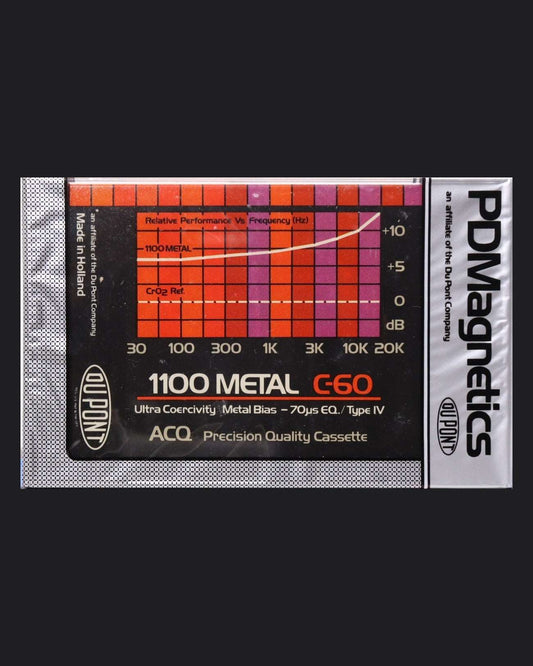
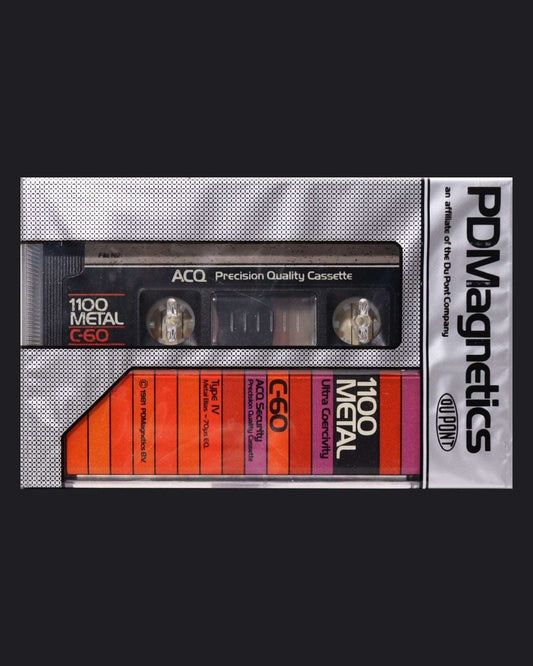
PD Magnetics / DuPont Blank Cassette Tapes
PD Magnetics — PDM standing for Philips-DuPont Media — was a joint venture formed in 1968 between two companies that together invented the two most fundamental elements of the cassette tape format: Philips, who created the compact cassette itself in 1963, and DuPont, who invented and commercialized chromium dioxide (CrO₂) tape coating. DuPont assigned its chromium dioxide formulation the tradename Magtrieve when commercialized in the late 1960s; under the Crolyn name it became the basis for PD Magnetics' cassette line. This was, in the most literal sense possible, a collaboration between the inventor of the box and the inventor of what went inside it.
The significance of true chromium dioxide is technical and historical. CrO₂ crystals are perfectly formed and can be evenly and densely dispersed in a magnetic coating, producing higher signal-to-noise ratios and better high-frequency stability than the imperfectly formed ferric oxide particles used in Type I tape. However, most Japanese manufacturers — TDK, Maxell, Sony, Fuji — refused to pay DuPont's licensing royalties and developed their own cobalt-modified ferricobalt formulations instead. This is why the vast majority of "chrome" or "high bias" tapes are technically not chrome at all, but cobalt-doped ferric oxide. PD Magnetics cassettes, by contrast, used the genuine article: real CrO₂, the original chromium dioxide formulation, the material that defined the IEC Type II standard.
PD Magnetics lingered into the 1990s but never achieved significant market share, partly because pure chrome tapes required careful deck calibration and didn't always perform optimally in Japanese decks calibrated for ferricobalt formulations. The tapes are genuine historical curiosities — cassettes made by the people who invented both halves of the format.
Key model: 500 Crolyn HG (genuine CrO₂ Type II, produced in multiple vintages 1981–1983). All tapes are NOS sealed. Free US shipping on orders over $75.
Frequently Asked Questions
What does PD Magnetics stand for?
PDM stands for Philips-DuPont Media. PD Magnetics was a joint venture formed in 1968 between Philips — inventor of the compact cassette — and DuPont — inventor and patent holder of chromium dioxide (CrO₂) tape. The two companies that created the cassette format and the coating that defined Type II joined forces to produce tape together.
Is PD Magnetics tape made with real chromium dioxide?
Yes. PD Magnetics tapes use genuine CrO₂ — the original chromium dioxide formulation DuPont invented and trademarked as Magtrieve/Crolyn. This distinguishes them from the vast majority of 'chrome' or 'high bias' cassettes, which use cobalt-ferric oxide pseudochrome rather than true CrO₂.
How does real chrome CrO₂ tape differ from ferricobalt Type II?
True CrO₂ crystals are perfectly formed and uniformly dispersed in the magnetic coating, producing higher signal-to-noise ratios and superior high-frequency stability. Pure chrome tape has a distinctive waxy smell (absent in ferricobalt tapes) and may require slightly different calibration on decks optimized for Japanese ferricobalt formulations.
Why didn't Japanese manufacturers use chromium dioxide?
Most Japanese manufacturers — TDK, Maxell, Sony, Fuji — refused to pay DuPont's licensing royalties for CrO₂ technology and instead developed their own cobalt-modified ferric oxide formulations. These 'pseudochromes' performed similarly to CrO₂ without the royalty cost, and became the dominant Type II formulation worldwide.
How rare are PD Magnetics cassette tapes?
Very rare. PD Magnetics never achieved significant market share and lingered into the 1990s without carving a recognizable consumer presence. Sealed NOS examples — particularly the 500 Crolyn HG — are genuine historical curiosities: cassettes made by the joint venture of the two inventors of the cassette format itself.